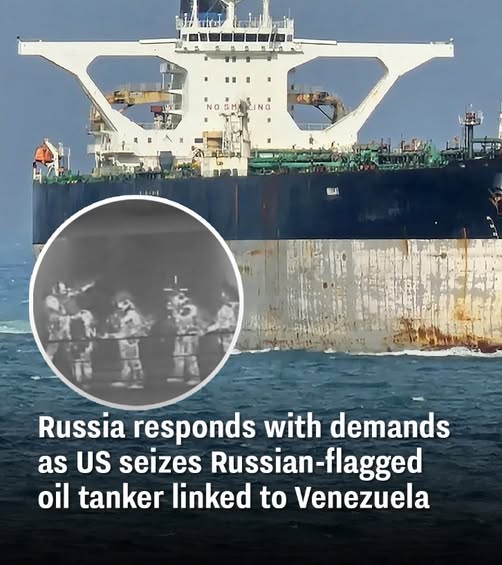
Russia Responds With Demands After US Seized Russian-Flagged Oil Tanker Linked to Venezuela
Tensions between Russia and the United States have intensified following Washington’s seizure of a Russian-flagged oil tanker in international waters. The vessel, identified by U.S. authorities as being connected to Venezuelan oil exports, was intercepted after what American officials described as a prolonged enforcement operation related to sanctions compliance.
The incident has prompted strong diplomatic reactions from Moscow, which argues that the action violates international maritime law and undermines long-standing principles governing freedom of navigation on the high seas. Russian officials have characterized the seizure as unlawful and have formally raised concerns about the treatment and status of the crew members involved.
While maritime interceptions are not uncommon in the enforcement of sanctions regimes, this case has drawn particular attention due to the vessel’s Russian registration, its alleged link to Venezuelan oil shipments, and the broader geopolitical context in which it occurred.
Background: Sanctions, Shipping, and Global Oil Trade
International sanctions have become a central tool in modern geopolitics, particularly in relation to energy markets. The United States has imposed a range of sanctions targeting Venezuela’s oil sector, aiming to limit the country’s ability to export crude oil and access global financial systems.
Because oil is typically transported by sea, shipping companies and tankers play a critical role in sanctions enforcement. Vessels suspected of facilitating restricted trade often face scrutiny, tracking, and, in some cases, interception by naval or coast guard forces.
At the same time, maritime law places strong emphasis on freedom of navigation, especially in international waters. Under widely recognized conventions, ships sailing on the high seas are generally subject only to the jurisdiction of the country whose flag they fly, except under narrowly defined circumstances.
It is within this legal and political tension—between sanctions enforcement and maritime sovereignty—that the seizure of the tanker Marinera has unfolded.
The Vessel: From Bella-1 to Marinera
According to available information, the oil tanker at the center of the dispute was previously known as Bella-1 before operating under the name Marinera. U.S. authorities allege that the vessel was involved in transporting Venezuelan oil in ways that violated American sanctions.
The tanker was sailing under the Russian flag at the time of interception. Russian officials have stated that the ship had received temporary authorization to operate under Russian registration toward the end of December, making it, in their view, a legally recognized Russian-flagged vessel.
This detail is central to Moscow’s protest, as flag registration determines which country has primary legal authority over a ship in international waters.
The Interception: A Weeks-Long Operation
U.S. officials have indicated that the tanker was intercepted in the North Atlantic following weeks of monitoring and pursuit. The operation was reportedly aimed at enforcing sanctions and preventing the vessel from completing activities Washington considers prohibited under U.S. law.
American forces eventually boarded the tanker and took control of it. While U.S. statements have focused on sanctions enforcement, Russian officials have emphasized the loss of communication with the vessel after boarding, raising concerns about transparency and procedural conduct.
Details regarding the exact circumstances of the boarding, including whether prior diplomatic channels were used, have not been publicly clarified by either side.
Russia’s Response: Diplomatic and Legal اعتراض
Russia’s Foreign Ministry responded forcefully, issuing a formal condemnation of the seizure. Officials described the action as an unjustified use of force against a ship lawfully operating under the Russian flag.
In its statements, Moscow referenced the 1982 United Nations Convention on the Law of the Sea, a cornerstone of modern maritime law. The convention affirms the principle that ships on the high seas fall under the exclusive jurisdiction of their flag state, except in cases such as piracy, unauthorized broadcasting, or slavery—none of which Russia says apply in this situation.
From Moscow’s perspective, the interception represents an overreach of U.S. authority and a precedent that could undermine international maritime norms if left unchallenged.
Crew Concerns: Treatment and Repatriation
In addition to legal objections, Russian authorities have raised humanitarian and consular concerns regarding the crew aboard the tanker. The Foreign Ministry has called on the United States to ensure that Russian nationals on the vessel are treated with dignity and in accordance with international standards.
Moscow has also requested that the crew be allowed to return home promptly, emphasizing that seafarers should not become collateral participants in geopolitical disputes.
Such requests are common in maritime incidents involving foreign crews, as international law places obligations on states to ensure the welfare of detained or intercepted sailors.
Transport Ministry Objections and Communication Issues
Russia’s Transport Ministry has echoed the Foreign Ministry’s criticism, focusing specifically on operational and communication issues surrounding the incident. Officials stated that contact with the tanker was lost after U.S. forces boarded it, a development they described as unacceptable.
The ministry reiterated that the vessel’s registration under the Russian flag had been properly authorized and that this status should have been respected by other states operating in international waters.